
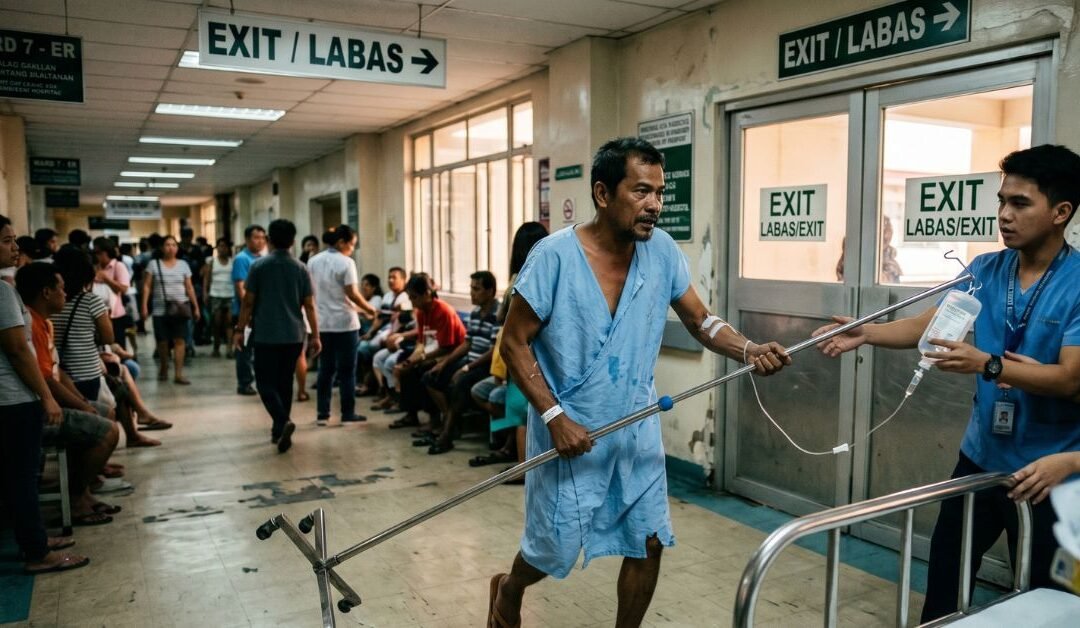
Let's talk about getting healthcare on a middle class budget here in the Philippines.
There's this post about how a patient was denied Philhealth coverage because the person's confinement did not reach 24 hours. The person was just admitted and passed away not long after. So, no coverage. And even if the confinement reached 24 hours, Philhealth would have only covered P73K of a P2M procedure that was needed.
Imagine, paying decades for mandatory Philhealth contribution only for it to be useless at sickness and death. Unfortunately, the story is not unique.
Health emergencies cost a lot. You can do everything right, pay your contributions, tick all the boxes, and one unlucky weekend can still take a bite out of years of saving. So let us talk honestly about healthcare in the Philippines when you are middle class, when you are an OFW thinking of coming home, or when you are a foreigner planning to retire here. Not the brochure version. The real numbers.
First, who are we even talking about
When I say middle class, I am not being vague about it. We have pegged the middle-class household (a family of around five) to earn around P30K to P120K. That is a wide band. The point is that some of us reading this are squarely in the "comfortable but not rich" zone, the kind of household where a P30,000 hospital bill does not bankrupt you, but it definitely ruins the year.
And here is the sobering bit. A 2025 BCG Manila report found that up to 64 percent of Filipinos cannot pay a P10,000 hospital bill without borrowing. Ten thousand. That is barely a private room for two nights. So if you can read this and not panic at that figure, congratulations, you are already ahead of two-thirds of the country. That is also exactly why this stuff matters more for us, because we have something to protect.
PhilHealth: the floor, not the ceiling
Let us start with the one almost everyone has. PhilHealth is mandatory. It is cheap. It has its uses. Just do not mistake it for a safety net that catches everything.
For 2026, the premium rate is 5 percent of your monthly basic salary, with a floor of P10,000 and a ceiling of P100,000. In plain terms, the minimum is P500 a month and the maximum is P5,000 a month. PhilHealth confirmed this is the final scheduled adjustment under the Universal Health Care Law (RA 11223), so no surprise hikes this year.
How it actually hits your wallet depends on what kind of member you are:
- Employed: The 5 percent gets split 50-50 with your employer. So if your basic is P45,000, the total premium is P2,250, but only P1,125 comes out of your payslip. Your boss covers the rest. Not bad.
- Self-employed, freelancer, or voluntary: You shoulder the whole 5 percent yourself. Same P45,000 income means P2,250 a month, all on you. This is the part that stings for the work-from-home crowd, and yet skipping it is a terrible idea.
- Senior citizens (60 and up): Fully exempt under RA 10645. Coverage is automatic and government-subsidized. If your parents are seniors, they are covered whether or not they ever paid a peso.
Now, what does that money actually buy you? PhilHealth pays through fixed case rates, meaning a set amount per condition, not a percentage of your bill. There is also the YAKAP primary care package (the rebranded Konsulta), which gives active members 75 free medicines, 13 free lab tests, and 6 cancer screenings at accredited clinics. That part is genuinely good and most people never use it. Go claim it.
There has been real movement on benefits lately, too. As of early 2025, PhilHealth raised severe dengue coverage to P47,000 (from P16,000) and mild dengue to P19,500 (from P10,000). Given how dengue season turns Metro Manila into a mosquito buffet every year, that is a meaningful bump.
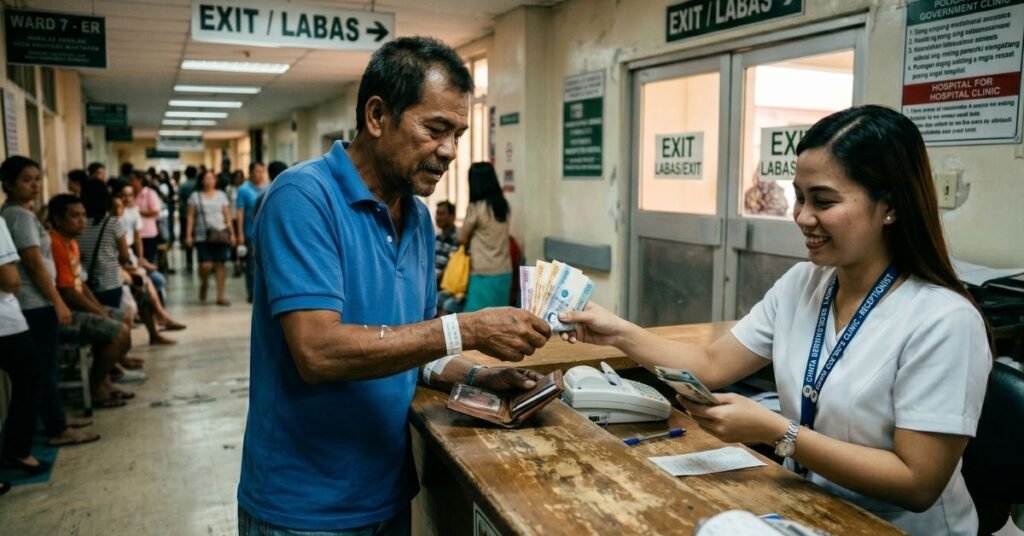
The gap nobody warns you about
Here is where I have to be the bearer of bad news. PhilHealth pays a fixed package, not your actual bill. The difference between those two numbers is what comes out of your own pocket, and it can be brutal.
Take my friend's appendectomy. PhilHealth lists the surgeon's professional fee coverage for an appendectomy at around P6,720, while the fee doctors actually consider acceptable sits somewhere between P20,000 and P40,000. See the problem? The system pays you a jeepney fare and the actual ride costs a Grab ride.
A few more real numbers to make this concrete:
- A laparoscopic gallstone procedure can run around P68,000 at a leading private hospital, even after PhilHealth. Gallstones, by the way, are extremely common here, no thanks to all the lechon and sisig floating around.
- A stroke is the nightmare scenario. Standard treatment can hit P1.8 million, where PhilHealth knocks off maybe P76,000 and an employee HMO covers around P90,000, leaving you staring at the rest. That is not a typo.
- Even a "simple" four-day dengue confinement landed one patient a roughly P60,000 bill once you add room, labs, meds, and professional fees.
PhilHealth also caps you at 45 inpatient days per year, with your dependents sharing another 45 between them. And those comfy amenities, the private room, the special nursing, the deluxe everything? Those are upgrades you pay for. PhilHealth covers the medically necessary, not the comfortable.
The macro picture confirms what your tita has been complaining about all along. Out-of-pocket health spending in the Philippines hit more than P615 billion in 2024, nearly half of total health expenditure. Translation: as a country, we are still paying for almost half our healthcare directly out of our own wallets. PhilHealth helps. It does not save you.
Where private insurance and HMOs come in
This is the layer that turns "ruined quarter" into "annoying week." An HMO is what covers your day-to-day, the consults, the lab tests, the cashless hospital admission, the stuff PhilHealth was never built to handle smoothly.
The good news is that you have options at almost every budget. According to a 2026 provider comparison, individual plans start as low as P999 a year for outpatient-only coverage, while full inpatient plus outpatient coverage typically runs P11,000 to P45,000 a year depending on your age and coverage level.
A few things I have learned the hard way about HMOs:
- Pre-existing conditions are the catch. Most standard plans only cover pre-existing conditions starting on your second year of continuous membership. So if you already have hypertension or diabetes, do not expect day-one coverage. Sign up before you get sick, not after.
- The MBL is the number that matters. Your maximum benefit limit per illness is what actually determines whether you get balance-billed. A low MBL means a big bill still finds its way to you.
- HMOs cover routine, not catastrophe. For the P1.8-million-stroke type events, even a good HMO runs out fast. That is what critical illness riders and life-insurance-attached health plans are for.
One more wrinkle worth budgeting for: medical inflation. A WTW survey projected Philippine medical costs to climb around 18.3 percent in 2025, and they expect that trend to continue. Your P15,000 plan today does not buy the same protection in five years. Plan for the cost of staying covered to keep rising.
If your budget is tight, a sensible stack for a middle-class family looks like this: PhilHealth as the mandatory base, one affordable HMO for everyday care and cashless admission, and if you can swing it, a critical illness rider for the catastrophic stuff. Even targeted micro-plans help. There are dengue-specific plans at around P599 for up to P30,000 of coverage, which is the kind of small, smart hedge I actually like.
For the OFWs thinking of coming home
If you are reading this from Dubai or Toronto or somewhere with a winter, listen up, because your situation has a few quirks.
Under the UHC Law, all overseas Filipinos are technically covered by PhilHealth as direct contributors. The premium is based on your income. Now, here is the nuance that trips people up: years ago, PhilHealth was directed not to enforce mandatory contributions on OFWs, so for many of you it has been functionally voluntary. That is convenient until the day you actually need it.
My advice? Keep your PhilHealth active even while you are abroad. The reason is the benefit eligibility period. To claim smoothly, you generally need a qualifying contribution history, and letting your status lapse means scrambling to settle missed contributions right when you can least afford the stress. Your dependents in the Philippines can also use the benefits while you are still overseas, which is reason enough for a lot of families.
If you have already taken up dual citizenship, you are covered too. Filipinos with dual citizenship can register under PhilHealth, historically pegged at around P3,600 a year, though you will want to confirm the current rate based on your declared income since the 5 percent rules now apply broadly. Either way, the door is open. Just walk through it before the emergency, not during.
For the foreigners: SRRV and Balikbayan visa holders
Now for the expats and would-be retirees. Healthcare access is one of the genuinely underrated perks of settling here, but it depends heavily on your status.
SRRV holders. The Special Resident Retiree's Visa is the gold-standard route for retiring here, and one of its listed perks is access to PhilHealth at a special membership rate via an agreement between the PRA and PhilHealth. In practice, the annual PhilHealth premium for foreign retirees on a visa runs around US$250, which at current exchange rates is roughly P14,000 a year. For that money you get into the same national system as everyone else. Worth noting the program got more accessible recently: as of September 2025, the minimum age dropped to 40, with higher deposits for the younger bracket.
That said, most expat retirees I have come across treat PhilHealth as a base and layer private or international health insurance on top for faster access and broader coverage at the better private hospitals. Given the case-rate gaps I described earlier, that is the smart move. PhilHealth is a floor for you too, not a ceiling.
Foreigners more generally. You do not actually need to be a retiree to get in. Foreigners can qualify for PhilHealth through employment in the Philippines, through legal residency, or by marrying a Filipino citizen. If you are employed by a Philippine company, enrollment is mandatory and your employer handles it. If you are here independently, you can register voluntarily under the Informal Economy Member category. Bring your passport, visa, and proof of residency.
Balikbayan visa holders, read this carefully. The Balikbayan privilege is the one people most often misunderstand. It gives former Filipinos and the foreign-passport-holding family members of a returning Filipino a one-year visa-free stay under EO 408. That is an immigration convenience, not a healthcare status. The Balikbayan stamp by itself does not enroll you in PhilHealth. If you are a former Filipino, the cleaner path is to re-acquire your citizenship under RA 9225, which then opens up PhilHealth and the other government programs. If you are a foreign spouse here on the Balikbayan privilege, your realistic options are private or international insurance, or qualifying for PhilHealth through one of the routes above once you sort out a longer-term visa. Do not assume the one-year stamp comes with a hospital card. It does not.
So what should you actually do
Strip away all the acronyms and it comes down to a few moves that apply whether you are a Makati yuppie, a returning seafarer, or a retiree from Munich:
- Get PhilHealth active and keep it active. It is relatively cheap, it is the legal base layer, and the lapse-then-scramble routine is genuinely painful.
- Add an HMO before you get sick. The pre-existing condition clock starts at enrollment, so the best time to sign up was last year and the second-best time is today. Match the MBL to the kind of hospital you would actually want to be admitted to.
- Build a medical emergency buffer anyway. Because even with PhilHealth and an HMO, my appendix friend still paid out of pocket. Assume a gap and pre-fund it. A dedicated portion of your emergency fund earmarked for health is not paranoia, it is arithmetic.
- For the catastrophic stuff, look at critical illness coverage. The P1.8-million scenarios are rare, but they are exactly the ones that wipe out a middle-class family. That is the whole point of insurance.
The good thing is that you can plan something but it will cost you a few thousand pesos a year if you act quickly. The flip side will definitely cost you a lot more. So go check if your policies are even active right now.
This post is for general information only and is not financial, medical, or insurance advice. Premiums, benefit packages, and visa rules change, so always confirm current figures directly with PhilHealth, the PRA, or your insurer before making decisions. When in doubt, talk to a licensed financial advisor or insurance agent about your specific situation.