

Almost everyone I know has a BPO chapter in their story. I have friends who did very well in the industry even if they came from more humble beginnings. They walk into a call center floor and they can walk out years later with a car, a credit score, and a permanent caffeine dependency.
For a whole generation of Filipinos, the call center was the side door into the middle class. It became the viable alternative to becoming an OFW. No need to leave the country. No need to kiss your family goodbye. Just a passable American accent, a tolerance for graveyard shifts, and a lot of patience and grit dealing with irate and angry customers. Those were enough to get anyone started in the call center industry. Other industries did thrive with the BPO outsourcing sector as well, with tech jobs becoming really lucrative career paths.
But like every shortcut to comfortable living, the BPO life comes with a price tag that does not show up on your payslip. Let's talk about all three parts of the deal: the stability, the sacrifice, and the ceiling nobody warns you about.
The stability nobody saw coming
Let's start with why the older folks stopped side-eyeing the call center kids.
The industry that we casually call "BPO" (officially the IT and business process management sector) closed 2025 with around $40 billion in export revenues and about 1.9 million workers on payroll. That is more than 8 percent of the entire country's GDP coming from people talking into headsets and processing claims for clients halfway across the planet.
Here is the part that still surprises people. The Philippines has been the world's number one BPO destination since 2010, when we quietly overtook India. And those export earnings now rival, and in some years exceed, the $35.6 billion our OFWs sent home in 2025. Two giant rivers of dollars keep this economy standing, and one of them flows from people who never had to leave Antipolo.
Now bring it down to the level that actually matters - your own kitchen table.
A fresh entry-level agent in Metro Manila starts somewhere around ₱18,000 to ₱25,000 a month. Compare that to the regional minimum wage, which for a lot of fresh grads in non-voice jobs lands closer to ₱13,000 to ₱15,000. So a 21-year-old with zero corporate experience could suddenly out-earn cousins who finished "better" degrees. Throw in the night differential (10 to 30 percent on top), an HMO from day one, the mandatory 13th month, and language premiums for the brave souls handling Japanese or Italian accounts, and the math gets genuinely life-changing.
This is the quiet revolution. For decades, the only way for a regular Filipino to reach for a dollar-backed salary was to physically leave. The BPO boom rewrote that. You could stay home, eat your mom's adobo, sleep in your childhood bedroom, and still build an emergency fund. (If you actually built one. We'll get to that.) It is the closest thing we have to a middle-class on-ramp that does not require a plane ticket.
So yes, stability. Real stability. Pero may katapat.

The sacrifice: the body-clock tax
Every BPO agent pays a tax that the BIR never collects. I call it the body-clock tax.
To serve clients in New York or California, you flip your entire life upside down. You sleep when the sun is out and live when the rest of the country sleeps. Your "lunch" is at 2 AM. Your weekend is a Tuesday. Family birthdays, fiestas, your own kid's recital, all of it happens on a schedule your body is no longer synced to.
And the body keeps the receipts. Academic research on the Philippine BPO workforce has tracked attrition rates sitting consistently around 50 percent a year, spiking as high as 80 percent in some centers, driven heavily by physical and psychological strain. Night-shift agents show higher rates of depression than their day-shift counterparts. Studies have flagged everything from burnout among young female employees to elevated breast cancer risk tied to chronic graveyard work, plus the everyday stuff: hypertension, high cholesterol, wrecked sleep, and the skin to match.
Then there is the part the medical journals do not measure: what the sacrifice does to your wallet.
This is where I have to play the kuripot uncle for a second. The body-clock tax creates its own spending logic. You are tired, you are stressed, you just survived eight hours of an irate customer in Ohio, and you feel like you have earned a treat. So there is the after-shift milk tea. The Grab home because the commute at 5 AM is brutal. The payday inuman with the team. The vape. The gadget upgrade you "deserve."
Multiply small comforts by a dollar-ish salary and you get textbook lifestyle creep. The premium that was supposed to lift you into the middle class quietly leaks out the same month it arrives. I have watched friends earn good BPO money for eight years and have almost nothing to show for it, because the sacrifice convinced them they were entitled to spend it all back. The cruel irony: the harder the job punishes you, the more it tempts you to spend the reward.
The ceiling: actually, there are two
Here is the part nobody puts in the recruitment poster.
Ceiling one is the career ceiling. The BPO structure is a pyramid, and it narrows fast. You come in as an agent, maybe you become a subject matter expert, then a team leader at ₱35,000 to ₱45,000, then if the stars align, an operations manager at ₱70,000 and up. But there are only so many TL and manager seats per hundred agents. For most people, the salary plateaus in the ₱25,000 to ₱35,000 band and just... sits there. For years. You can be excellent on the phones and still hit a wall, because being great at the entry-level job does not automatically open the next door. The on-ramp is wide. The staircase is narrow.
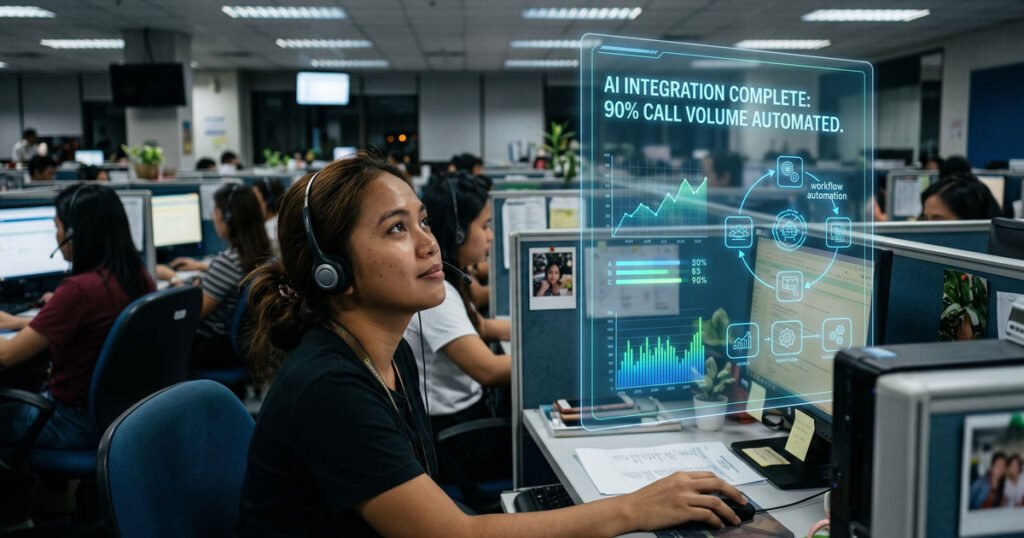
Ceiling two is the one keeping CEOs up at night: AI.
This is no longer a sci-fi worry. The International Labour Organization has estimated that 89 percent of BPO jobs face a high risk of automation. A 2025 IMF study found that roughly a third of all Philippine jobs are highly exposed to AI, and the BPO sector carries the single greatest specific risk. Industry forecasts get blunter: one major firm projects a net loss of 300,000 BPO jobs over five years, offset by only 100,000 new positions, many of them lower-paying and short-term. DOLE has already acknowledged early displacement as a handful of firms quietly shut down local operations.
Before you panic and shred your headset, the same data has a second half worth reading.
The IMF found that even among the heavily exposed BPO roles, about 61 percent are "highly complementary," meaning AI is more likely to assist those workers than to fire them. The model emerging across Philippine floors in 2026 is augmentation, not extinction.
AI eats the boring, repetitive calls so agents can handle the messy, emotional, judgment-heavy issues that a chatbot still mess up. The Filipino edge, the empathy and the cultural fluency, is exactly what the machines are worst at. And there is a real upside for the prepared: AI-certified and specialized roles are reportedly commanding meaningfully higher pay.
But notice which rung is getting kicked away first. It is the bottom one. The simple, routine, entry-level tasks - the exact jobs that served as the middle-class on-ramp for the last two decades - are the easiest to automate. The industry will likely keep growing in revenue and shift toward higher-value work. The question is whether the next 21-year-old with no plan still gets the same wide-open door that an entire generation walked through.
What this means for your money
So what do you actually do with all this? Depende kung saan ka nakatayo.
If you are currently in BPO, treat the stability as a window, not a destination. The dollar-backed years are a gift, but they are not guaranteed forever. Three moves:
First, build the emergency fund before you build the lifestyle. Three to six months of expenses, parked somewhere boring and untouchable. The job that flips your body clock is exactly the job you want a financial cushion for.
Second, beat the lifestyle creep on purpose. Bank the night differential. Automate the savings the day the salary lands, before the milk tea and the Grab and the inuman get their cut. Pay yourself first, then live on what is left.
Third, climb out of the automatable zone. Upskill into the specialized, AI-adjacent, or leadership roles that the machines complement instead of replace. Languages, analytics, account management, the higher-value stuff. The agents who treat AI as a tool to master will be the ones still standing, and earning more.
And if you are an OFW reading this from Dubai or Riyadh, weighing a comfortable comeback? The BPO floor is a genuinely soft landing. Familiar work, decent pay, no visa to renew. Just walk in with your eyes open about the ceiling, because the soft landing is only soft if you do not plan to stay at the bottom forever.
The BPO industry gave this country a middle class without an airport. That is no small miracle. But a side door into comfort is still just a door. What you build once you are inside the room - that part was always up to you.
Kayo, ano sa tingin niyo? Is the BPO life still the on-ramp it used to be, or are we watching the door slowly close on the next generation? Sound off in the comments.