
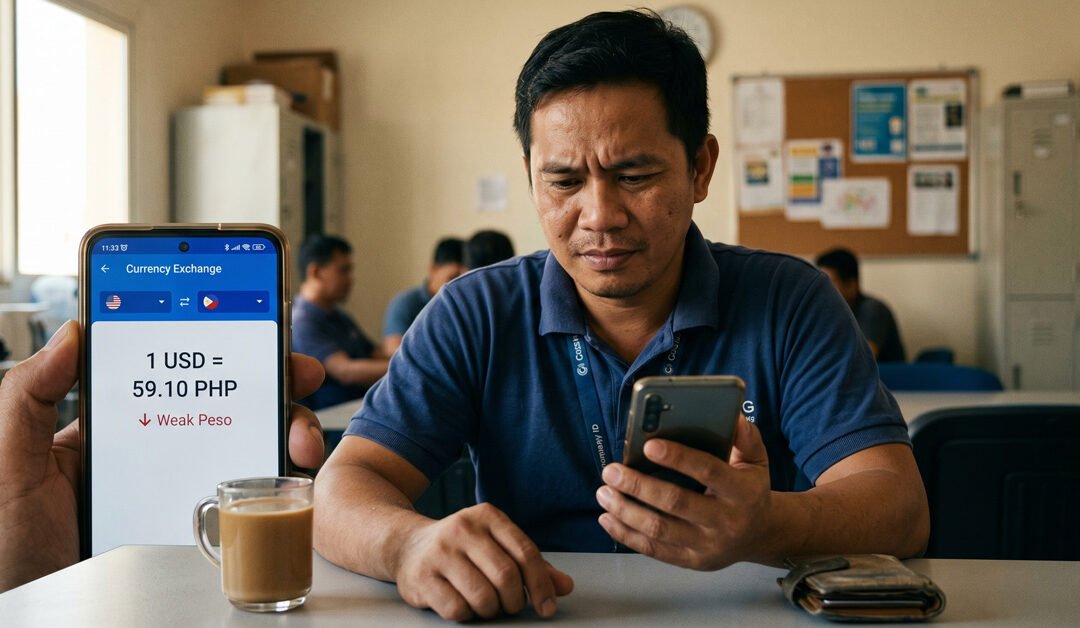
There is a special kind of energy in the family group chat whenever the peso slides. Some tito drops a screenshot of the exchange rate. A cousin asks if now is the time to magpadala ng marami. Somebody inevitably types "buy condo na!" with three fire emojis. And you, the actual kabayan who earned that money under a Gulf sun or through a brutal Canadian winter, are left squinting at your banking app wondering if you should ride the wave or just sit tight.
Here is the thing. The wave is real. As of mid-2026 the peso has been hovering near record-weak territory, trading around ₱60 to ₱61 to the US dollar after touching an all-time low past ₱62 earlier in the year, based on Bangko Sentral and market data. For our kababayans in Dubai and the UAE, the dirham has been buying somewhere around ₱16.5 to ₱16.7, close to its 12-month high of ₱16.87 set in May.
So no, you are not imagining it. It's nice to be earning something other than the peso right now. Your hard-earned foreign currency genuinely stretches further than it did a year or two ago.
The question the kabayan should be asking is not "should I convert." It is "what do I actually do with the pesos once I have them, so I am not just watching them quietly evaporate."
Quick disclaimer: We're not licensed financial advisors. We're just outlining possibilities and options, and we've watched too many people get burned. Treat this as a starting point, not gospel, and check with a professional before any big move.
First, the good news
You are in good company, and the timing is not an accident. Overseas Filipinos sent home a record $35.63 billion in cash remittances in 2025 and part of that surge happened precisely because many OFWs waited to convert at the strongest possible rate. The US remained the biggest source at nearly 40 percent, with Saudi Arabia, the UAE, and Singapore also in the top ranks. Plenty of OFWs already figured out that a weak peso means a lot more for their foreign money.
So the win is on the table. The trick is not letting the win slip through your fingers.
Now, the catch nobody puts in the group chat
A weak peso is not pure upside, and here is the part people conveniently skip.
Inflation is eating your pesos while they sit. Philippine inflation cooled to 6.8 percent in May 2026, but the year-to-date average is still around 4.5 percent, above the government's 2 to 4 percent target. In plain terms, pesos parked in a regular passbook account earning a quarter of a percent are losing real buying power every single month. The strong-dollar gain you were so happy about gets silently chewed up if the money just lounges around doing nothing.
US-based kabayan, mind the new tax. A 1 percent tax on remittances sent from the US took effect in 2026. It is small per transaction, but it adds up, and it is one more reason to batch your transfers sensibly instead of sending dribs and drabs.
Spreads are real. The headline BSP rate is not what you get at the counter. Banks and money changers add their markup, so compare your remittance channel's actual peso payout, not just the screenshot rate.

The traps to avoid
Before the "what to do," let me save you from the "what not to do," because this is where most of the strong-dollar windfall goes to die.
Do not try to time the peso like a day trader. I have seen kabayan refresh the exchange rate app like it is a slot machine. Forecasters cannot even agree with each other. Some models see the peso clawing back toward ₱59, others see it sliding further. If the pros are guessing, you betting your whole sahod on the perfect rate is just gambling with extra steps.
Steer very clear of "guaranteed high returns." This is the big one for OFWs, because scammers know you have capital and you are far from home. Anything promising 20 to 30 percent a month, "double your money," online paluwagan run by a stranger, or a crypto "investment group" admin who slides into your DMs is a red flag the size of EDSA. Legitimate, safe returns in the Philippines right now top out in the single digits. If it sounds too good to be true, it is a budol.
Read the boosted-rate fine print. Digital banks love advertising eye-watering numbers like 15 percent. Look closer and those boosted rates usually require monthly spending missions that reset every month. The number you can actually count on is the base rate. Plan around that, and treat any boost as a bonus.
Beware of lifestyle creep at home. When the padala suddenly looks huge in pesos, families spend bigger. New phone here, a fancier handaan there, and the "extra" is gone before it ever became savings. The strong dollar should be building your buffer, not everyone's Shopee cart.
The safer plays: what to actually do
Here is the boring, unsexy, actually-works list. None of these will make you rich overnight, which is exactly the point.
1. Top up your emergency fund first. Three to six months of household expenses, kept liquid and reachable. It is not glamorous, but an OFW without a cushion is one medical emergency or one lost contract away from disaster. Build this before chasing any yield.
2. Park cash in PDIC-insured digital banks and time deposits. Good news here: the Philippine Deposit Insurance Corporation now covers up to ₱1 million per depositor, per bank, doubled from ₱500,000 effective March 2025, and that protection covers both peso and foreign currency deposits. Reputable digital banks pay base rates in the 3 to 4 percent range, with time deposits running roughly 4.75 to 6 percent depending on the term. A simple diskarte: spread your money across two or three banks so each stash stays under that ₱1 million insured ceiling.
3. Look hard at Pag-IBIG MP2. This is the quiet middle-class champion. The Modified Pag-IBIG 2 (MP2) program is voluntary, government-backed, and locked for five years, and it paid a 7.12 percent dividend for 2025, tax-free. Tax-free matters: a 7 percent return you fully keep beats a higher "headline" rate that gets whittled down by withholding tax. OFWs are eligible, and you can manage it through Virtual Pag-IBIG without flying home.
4. Consider government securities. Retail Treasury Bonds and other instruments from the Bureau of the Treasury (accessible through apps like Bonds.PH and partner banks) are backed by the national government and have been yielding north of 5 percent. About as safe as it gets in pesos, with returns that comfortably beat a savings account.
5. Pay down high-interest peso debt. If you are carrying a credit card balance charging 3 percent or more a month, wiping it out is a guaranteed, risk-free "return" that no investment can promise. Boring, but unbeatable.
6. Do not convert everything in one shot. Unless you have a specific bill due, resist the urge to dump your entire savings into pesos at one rate. Convert in tranches or batches across several months, the peso-cost-averaging version of currency conversion, and keep a sensible buffer in dollars or dirhams abroad for your day-to-day life. The rate moves both ways.
A simple saktong burgis way to split it
If you want a rough mental model, not a prescription: fund the emergency cushion first, then put the bulk of your ipon into a mix of insured savings, MP2, and government bonds.
Keep a small slice for higher-risk bets only if you can afford to lose it entirely, and hold on to some foreign currency so you are not fully exposed to peso swings. Adjust the proportions to your own timeline, whether you are saving for an eventual comeback home, a kid's tuition, or a far-off retirement.
The weak peso is not really a windfall. It is a window. Windows close. What separates the kabayan who builds something lasting from the one who just had a good month is what they do in the boring weeks after the exciting screenshot.
So before you forward that exchange rate to the group chat: saan mo dadalhin ang panalo? Where is your strong-dollar win actually going to live?
It sucks for the rest of us who earn purely in Philippine pesos though.